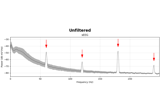
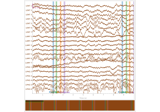
line_filter
- line_filter(raw: BaseRaw | BaseEpochs | Evoked, fs: float = None, freqs: int | float | ndarray | list | tuple = 60.0, filter_length: str = '10s', notch_widths: int | float | ndarray | list | tuple = 10.0, mt_bandwidth: float = None, p_value: float = 0.05, picks: list[int | str] = None, n_jobs: int = None, adaptive: bool = True, low_bias: bool = True, copy: bool = True, *, verbose: int | bool | str = None) BaseRaw | BaseEpochs | Evoked[source][source]
Apply a multitaper line noise notch filter for the signal instance.
Applies a multitaper power line noise notch filter to the signal, operating on the last dimension. Uses the F-test to find significant sinusoidal components to remove. This is done by fitting a sinusoid to the power spectrum at each time point and frequency, and testing whether the resulting fit is significantly different from a flat spectrum. The significance test is done using an F-test, which requires fitting two models (one flat, one sinusoidal) at each time point and frequency. The F-test is corrected for multiple comparisons using the Benjamini-Hochberg procedure.
- Parameters:
raw (
mt_utils.Signal) – Signal to filter.fs (
float, optional) – Sampling rate in Hz. Default is taken from the raw object.freqs (
float | array-likeoffloat, optional) – Frequencies to notch filter in Hz, e.g. np.arange(60, 241, 60). None can only be used with the mode ‘spectrum_fit’, where an F test is used to find sinusoidal components.filter_length (
str | int, optional) – Length of the filter to use. If str, assumed to be human-readable time in units of “s” or “ms” (e.g., “10s” or “5500ms”). If an int, it is assumed to be in samples and used directly.notch_widths (
float | arrayoffloat, optional) – Width of the stop band (centred at each freq in freqs) in Hz. Default is 10.mt_bandwidth (
float, optional) – The bandwidth of the multitaper windowing function in Hz. Default will set the half frequency bathwidth to 4 Hz.p_value (
float, optional) – P-value to use in F-test thresholding to determine significant sinusoidal components to remove. Note that this will be Bonferroni corrected for the number of frequencies, so large p-values may be justified.picks (
str | array-like | slice | None) – Channels to include. Slices and lists of integers will be interpreted as channel indices. In lists, channel type strings (e.g.,['meg', 'eeg']) will pick channels of those types, channel name strings (e.g.,['MEG0111', 'MEG2623']will pick the given channels. Can also be the string values'all'to pick all channels, or'data'to pick data channels. None (default) will pick all channels. Note that channels ininfo['bads']will be included if their names or indices are explicitly provided.n_jobs (
int | None) – The number of jobs to run in parallel. If-1, it is set to the number of CPU cores. Requires thejoblibpackage.None(default) is a marker for ‘unset’ that will be interpreted asn_jobs=1(sequential execution) unless the call is performed under ajoblib.parallel_configcontext manager that sets another value forn_jobs.adaptive (
bool, optional) – Use adaptive weights to combine the tapered spectra into PSD. Default is True.low_bias (
bool, optional) – Only use tapers with more than 90 percent spectral concentration within bandwidth. Default is True.copy (
bool, optional) – If True, a copy of x, filtered, is returned. Otherwise, it operates on x in place.verbose (
bool | str | int | None) – Control verbosity of the logging output. IfNone, use the default verbosity level. See the logging documentation andmne.verbose()for details. Should only be passed as a keyword argument.
- Returns:
filt – The signal instance with the filtered data.
- Return type:
mt_utils.Signal
Notes
The frequency response is (approximately) given by
1-|----------         -----------
  |          \       /
  |           \     /
  |            \   /
  |             \ /
0-|              -
  |         |    |    |         |
  0        Fp1 freq  Fp2       Nyq
For each freq in freqs, where
Fp1 = freq - trans_bandwidth / 2andFs2 = freq + trans_bandwidth / 2.References
Multi-taper removal is inspired by code from the Chronux toolbox, see www.chronux.org and the book “Observed Brain Dynamics” by Partha Mitra & Hemant Bokil, Oxford University Press, New York, 2008. Please cite this in publications if this function is used.
Examples
>>> import mne
>>> from bids import BIDSLayout
>>> from ieeg.io import raw_from_layout
>>> bids_root = mne.datasets.epilepsy_ecog.data_path(verbose=False)
>>> layout = BIDSLayout(bids_root)
>>> raw = raw_from_layout(layout, subject="pt1", preload=True,
... extension=".vhdr", verbose=False)
Reading 0 ... 269079  =      0.000 ...   269.079 secs...
>>> mne.set_log_level("WARNING")
>>> filt = line_filter(raw, freqs=[60, 120, 180])
>>> mne.set_log_level("INFO")